


Not every inspection task should be immediately turned into a full-scale development project. Particularly in the case of complex features, difficult surfaces, high cycle rates or multiple product variants, it makes sense to carry out a thorough assessment of technical feasibility in advance.
OCTUM supports companies with feasibility studies and proof-of-concept projects for industrial image processing, AOI and in-line inspection. This enables you to establish a sound basis for decision-making before investing in implementation.

Any questions?
Get directly in touch with our
experts on +49 7062 91494-0
or write to us using our contact form
What information is helpful when getting started?
For an initial assessment, details regarding the inspection task and the production environment are particularly helpful. The more specific the information is, the easier it is to determine whether a feasibility study or a proof of concept is appropriate.
Some examples of things that can be helpful are:
- Product description or drawing
- Good parts and defective parts
- Sample images or videos
- Required inspection criteria
- Relevant defect patterns
- Cycle time and process environment
- Variants, formats or material differences
- Existing equipment or planned machine design
- Required interfaces or documentation requirements
Why a feasibility study is a good idea
In industrial image processing, the success of a project often hinges on details that cannot be reliably assessed at the outset. These include, for example, features that are difficult to detect, variable products, sensitive materials, low contrast, or very narrow process windows.
A feasibility study helps to systematically examine precisely these points in advance. Instead of making assumptions, you receive a well-founded technical assessment based on realistic trials and clearly defined criteria.
This provides certainty – technically, economically and organisationally.
The benefits of an OCTUM feasibility study
- Early clarity on technical feasibility
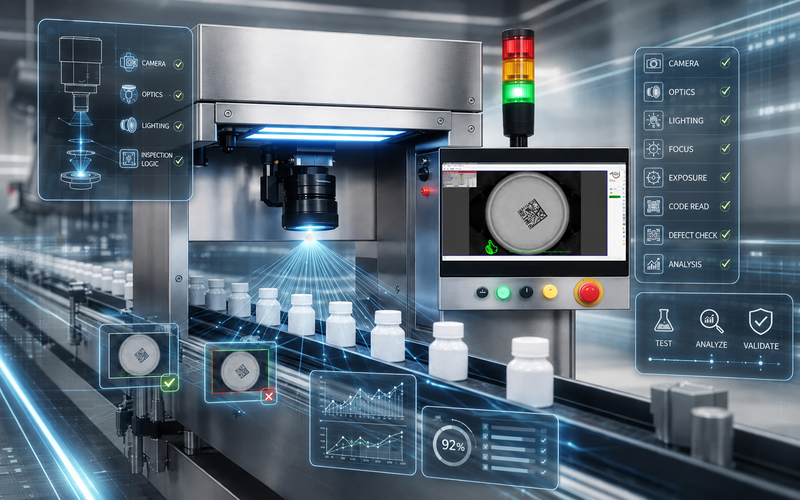
- Assessment of cameras, optics, lighting and inspection criteria
- Transparent evaluation of opportunities, limitations and risks
- A sound basis for project and investment decisions
- Less uncertainty prior to development, integration and series production
The tasks for which a proof of concept is particularly well suited
A PoC is particularly useful when:
- the technical feasibility is still unclear
- sensitive or hard-to-see features need to be assessed
- several product variants need to be taken into account
- surfaces, materials or geometries are complex
- tight cycle times or limited installation space are a factor
- reliable findings are required before making an investment
What is examined in a feasibility study
Every inspection task is different. That is why every feasibility study is tailored to the specific application. The aim is to identify critical factors at an early stage and evaluate the most suitable solution.
Typical parts of the test include:
- Visibility of relevant features
- Suitability of camera, optics and lighting
- Image quality and contrast performance
- Repeatability and process stability
- Impact of product variations and environmental conditions
- Feasibility within the given cycle time
- Technical risks and possible alternatives
What you will receive in the end
A good feasibility study does more than just give a simple yes or no. It provides you with a sound basis for your next decision.
Typical results include:
- Technical assessment of the inspection task
- Assessment of the fundamental feasibility
- Recommendation for a suitable approach
- Highlighting critical parameters and risks
- Proposal for the next logical implementation steps
This way, you’ll know early on whether and how a test task can be reliably incorporated into a project.
This is how a PoC works at OCTUM
1. Defining the inspection task
We discuss together which characteristics need to be inspected, which defects are relevant, and what requirements apply to your process.
2. Analysing the framework conditions
This includes, amongst other things, product characteristics, cycle time, environmental conditions, the range of variants, and any integration requirements.
3. Testing and evaluation
Based on the inspection task, we examine technical approaches and assess which combination of image capture, lighting and evaluation is appropriate.
4. Results and recommendations
You will receive a structured assessment providing a clear overview of feasibility, limitations, risks and next steps.
Why OCTUM?
OCTUM has been developing solutions for industrial image processing and automated optical inspection for over 30 years. With more than 6,000 systems installed in the field, we know what matters in real-world production environments.
Particularly when it comes to demanding inspection tasks, a thorough preliminary assessment is often the decisive factor between a robust solution and an unnecessarily risky project launch.
Have the feasibility of your inspection task assessed
Would you like to assess at an early stage whether your image processing or AOI task can be implemented reliably? Then get in touch with us. Together, we’ll determine whether a feasibility study or a proof of concept is the right first step for your application.
Please provide a brief description of your product, the relevant feature and the current challenge. We’ll get back to you with an initial assessment of whether a PoC makes sense for your application.